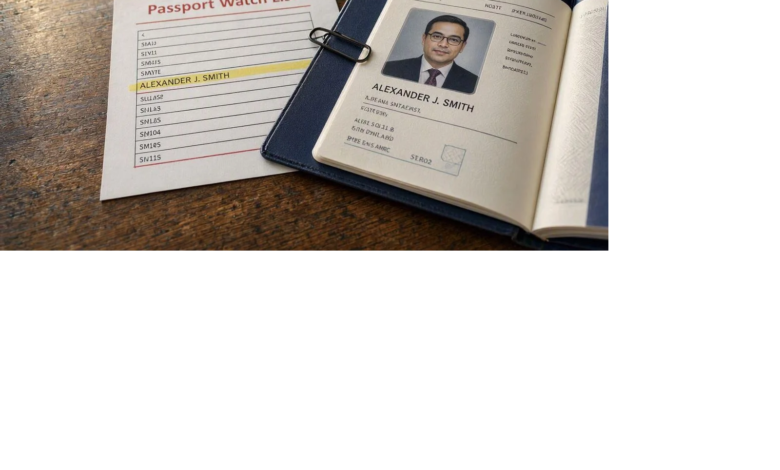
A passport or traveler may be flagged for closer examination because of security, immigration, document, customs, or law-enforcement concerns, but the screening alert does not necessarily authorize officers to arrest someone for extradition or another legal proceeding.
WASHINGTON, DC, September 25, 2026: A passport-system alert can interrupt check-in, trigger secondary inspection, delay a connection, or bring another government agency into an airport encounter, but the word “flagged” does not reveal why the traveler was selected or what officers may lawfully do.
Governments use numerous screening systems to check document validity, identity, immigration eligibility, customs concerns, aviation security, outstanding warrants, intelligence information, and international police alerts, so apparently similar checkpoint experiences can stem from legally unrelated records and operational instructions.
One traveler may be questioned and released after a spelling discrepancy is resolved; another may be denied boarding under an aviation-security rule; another may face immigration detention; and another may be arrested because the alert connects officers with an independently valid warrant.
The decisive issue is which database generated the result, what information supports it, which agency controls the record, and whether domestic law authorizes additional screening, a travel restriction, temporary detention, or an arrest.
“Passport Watch List” Describes Several Different Systems
The phrase “passport watch list” commonly describes many different government records, but it does not identify a single international database, standardized legal instrument, uniform inclusion test, or predictable consequence applying at every border and airport.
A record may concern the person presenting the passport, the document’s validity, an immigration violation, a visa condition, a security assessment, a customs investigation, a missing person, an outstanding warrant, or a request from another government agency.
Some lists exist only within one country, others connect several domestic agencies, and certain systems incorporate information from international organizations or foreign partners, creating major differences in access, review standards, disclosure rules, operational reach, and available remedies.
Using one informal label for every system can create misunderstandings because closer screening, refused transportation, immigration action, passport cancellation, and extradition arrest arise from different powers that must be analyzed independently under the relevant jurisdiction’s law.
The Passport Supplies Information for Screening
A modern passport supplies standardized biographical and document information, including the holder’s name, nationality, date of birth, sex, photograph, passport number, issuing country, expiration date, and electronic-chip data used to authenticate the document and compare it with the traveler.
Amicus International Consulting’s discussion of modern passport security features provides background on document verification, including machine-readable information and electronic security measures, which helps explain how an ordinary passport inspection begins before officers consider separate government records.
The passport does not ordinarily contain every police, intelligence, immigration, customs, or security record connected with its holder, because inspection equipment generally extracts identity information and uses external government systems to search for relevant alerts or restrictions.
An authentic, unexpired passport can therefore trigger a watch-list response when the holder’s identity is linked to separate government information, while a person without any adverse personal record can face questioning when the document appears lost, stolen, altered, revoked, or invalid.
An Alert Requires Interpretation
When an automated system returns a possible match, the initial result ordinarily prompts further examination rather than proving identity, wrongdoing, inadmissibility, dangerousness, or sufficient legal authority to place the traveler under custodial arrest at that checkpoint.
Officers may direct the person into secondary inspection, review the passport and supporting documents, compare biographical details, examine visa or immigration files, ask questions, and contact the agency responsible for the alert before determining the appropriate response.
Common names, inconsistent transliteration, shared birth dates, identity theft, expired records, data-entry mistakes, damaged documents, and similarities between unrelated travelers can produce false or uncertain matches requiring careful resolution by appropriately trained personnel.
Even when identity is confirmed, officials must still determine what the record requests, whether its instructions remain current, and whether the agency has the legal authority to take the proposed action.
Additional Screening Does Not Establish Watch-List Status
The FBI Threat Screening Center’s official guidance states that additional airport screening does not mean a traveler appears on the terrorism watch list and explains that most people disputing travel difficulties through federal redress procedures are not listed there.
Travelers can receive enhanced examination because of random selection, identification problems, document discrepancies, customs declarations, security procedures, or technical difficulties, so being questioned is an unreliable basis for concluding that an intelligence or criminal record exists.
The FBI also distinguishes the broader terrorism watch list from the smaller No Fly List, explaining that most people on the broader list can still fly within the United States, though they may face additional screening.
Those distinctions matter because security screening, permission to board, immigration admission, and criminal arrest are separate decisions, even when several occur in the same terminal and involve information associated with the same traveler.
Screening and Arrest Serve Different Legal Functions
Screening helps officials identify risk, verify identity, examine eligibility, inspect documents, or decide whether to notify another agency, whereas arrest involves a significant restraint of liberty that requires legal authority recognized by the jurisdiction controlling the encounter.
A watch-list entry may tell officers to ask specified questions, confirm an address, record travel information, notify investigators, inspect baggage, deny access to a program, or conduct additional security procedures without independently authorizing custodial arrest.
Arrest may become lawful when the screening result connects officers with an existing domestic warrant, immigration detention authority, judicial order, evidence supporting a newly discovered offense, or another statutory basis independent of the watch-list label.
This means a screening alert can contribute to an arrest without supplying the arrest power itself, much as a witness report can direct police toward a wanted person whose detention depends on an existing warrant.
Immigration Alerts Can Interrupt Travel
Immigration systems may flag expired status, a removal order, visa cancellation, previous overstay, an admissibility concern, a document discrepancy, an entry restriction, or a requirement for additional examination, none of which automatically constitutes an international extradition request.
A noncitizen might be refused entry, placed in immigration detention, returned to the departure point, referred to an immigration judge, or required to provide additional documents even without a foreign criminal warrant or INTERPOL Red Notice.
Immigration enforcement addresses the person’s right to enter or remain, while extradition addresses formal surrender to another jurisdiction for prosecution or punishment, creating materially different procedures, defenses, decision-makers, evidentiary requirements, and possible outcomes for the traveler.
The legal distinction remains important even when both processes could lead to departure from a country, because an immigration removal decision does not necessarily involve the treaty review and criminal-case documentation required for conventional extradition.
Document Alerts Concern the Passport’s Status
A passport may generate a response because it has been reported lost, stolen, revoked, canceled, or otherwise invalid, creating a document-security issue even when the presenter has no outstanding criminal warrant or extradition case.
Officers may contact the issuing authority, request another identity record, investigate the document’s history, retain it where legally authorized, or prevent its use for travel while determining whether the problem involves an administrative error or suspected fraud.
A traveler who finds a previously reported lost passport may therefore face difficulties even when presenting the original physical document, because recovering the booklet does not necessarily restore its validity in the issuing authority’s records or international document databases.
The document alert and the person’s legal status must be examined separately, since an invalid passport does not automatically establish criminal intent, while knowingly presenting a fraudulent document may create an independent basis for investigation or prosecution.
Customs Referrals Have Their Own Purpose
Customs agencies can select travelers for examination based upon declarations, baggage information, restricted goods, currency-reporting rules, agricultural controls, prior violations, intelligence, or random procedures, often operating independently from the systems used to identify people wanted for extradition.
A customs referral may lead to luggage inspection, questioning, seizure of prohibited goods, assessment of duties, civil penalties, or a criminal investigation if officers discover evidence supporting an offense within their territorial jurisdiction and legal mandate.
The passport scan preceding the inspection does not establish that the passport holder appeared on a criminal watch list, because the document may have simply linked a passenger record to a customs selection generated from other information.
If officers discover contraband or evidence of another offense, domestic law may provide arrest authority based on that discovery, but the legal basis would require more than the original notification directing the traveler toward additional screening.
Law-Enforcement Records May Request Notification
Investigators may ask authorized agencies to notify them when a person travels, applies for a visa, presents a particular document, or appears during another official encounter, subject to the legal standards governing the relevant information-sharing arrangement.
Such a record can help investigators confirm location or arrange lawful follow-up without establishing that the person is charged, convicted, wanted internationally, or immediately subject to arrest under the laws of the country where the encounter occurs.
The responding officer may confirm identity and communicate with the originating agency while allowing the traveler to proceed, particularly when the record requests information and no independent warrant or detention authority justifies further restrictions on movement.
Alternatively, the originating agency may confirm that an enforceable warrant remains active, allowing appropriately authorized officers to execute that warrant after resolving identity and satisfying the jurisdictional and procedural requirements that apply to the particular arrest.
Passenger Data Can Connect Different Agencies
Airlines transmit passenger information to governments under applicable national programs, allowing authorities to assess identities and itineraries before a traveler reaches a security checkpoint, departure gate, immigration booth, or connecting flight within the destination country.
That information can help officials resolve a possible match, contact another agency, or arrange enforcement when legal authority exists, but a reservation record or screening referral does not independently become an arrest warrant merely because agencies share it.
In April 2026, Reuters reported on TSA information supplied to immigration authorities, describing records concerning more than thirty-one thousand travelers and more than eight hundred subsequent immigration arrests during the period covered by internal agency data.
The reported relationship illustrates how travel information may help authorities locate people, while the legality of any individual arrest still depends upon the arresting agency’s powers, the person’s circumstances, and the applicable procedural requirements.
A Red Notice Communicates a More Specific Request
An INTERPOL Red Notice communicates that a member country or qualifying international tribunal wants an identified person located and provisionally arrested pending extradition, surrender, or similar action under an existing national warrant or judicial order.
INTERPOL does not issue a universally enforceable arrest warrant, determine guilt, or compel national authorities to arrest, because every member country applies its own laws when deciding how to respond after encountering the person described in the notice.
A general passport or traveler alert may have no connection with extradition, while a Red Notice specifically points toward a foreign wanted-person case and requests consideration of provisional detention for a formal international surrender process.
Even then, the encountering country may require a separate domestic warrant, formal provisional-arrest request, supporting judicial information, or other documentation before its officers can lawfully place the person into custody for possible extradition.
Extradition Detention Requires Further Legal Steps
Authorities considering provisional arrest may examine whether the traveler is correctly identified, the foreign warrant remains active, an extradition relationship exists, and the requesting country can provide the documentation required by the applicable treaty or legislation.
Amicus International Consulting’s material on international extradition procedures addresses the broader subject of foreign surrender requests, which can involve police, prosecutors, judges, central authorities, diplomatic communication, defense counsel, and executive officials, each with distinct responsibilities.
Provisional arrest ordinarily preserves the opportunity to consider extradition while the requesting government submits its formal materials, and deadlines for those documents depend upon the governing treaty and the domestic law of the requested country.
Detention at that stage does not establish guilt or guarantee surrender because the requested country must independently determine whether extradition satisfies its legal requirements, including applicable treaty conditions and protections against prohibited treatment or other recognized risks.
Secondary Inspection Can Involve a Restraint on Movement
A traveler directed into a separate inspection area may temporarily be unable to leave or continue toward a flight, but the legal characterization of that restriction depends upon local border powers, duration, purpose, conditions, and applicable judicial standards.
Officials use secondary inspection to resolve admissibility, identity, document, customs, or security questions, so missing a connection or spending time answering questions does not, by itself, prove an extradition arrest occurred.
Authorities nevertheless remain subject to applicable legal limits, and describing a restriction as screening does not automatically resolve whether its duration or conditions require additional justification, judicial oversight, access to counsel, or other procedural safeguards.
The most useful question is what authority officials are exercising at that stage, because the rights available during routine border examination can differ from those arising during criminal arrest, immigration detention, or provisional custody for extradition.
Similar Names Can Cause Repeated Difficulties
Name-based systems can confuse unrelated travelers when spelling, transliteration, birth dates, nationalities, or other fields overlap, particularly when an alert contains limited identifiers or the person sought uses several aliases that resemble another traveler’s lawful name.
Officers may compare facial images, fingerprints where lawfully available, passport history, birth records, immigration files, visa applications, or previous encounters before deciding whether the traveler corresponds with the individual described in the underlying government record.
A person repeatedly affected by mistaken identity may benefit from an official redress or correction procedure, because resolving one encounter does not necessarily correct the data or matching issue causing similar difficulties on later journeys.
For qualifying travel problems involving the United States, the Department of Homeland Security’s Traveler Redress Inquiry Program provides a review route, although an application does not guarantee disclosure of confidential records or exemption from future screening.
Public Searches Cannot Establish a Complete Travel Status
Many government watch lists and law-enforcement alerts remain confidential because disclosure could compromise investigations, reveal security methods, expose sensitive sources, undermine operations, or affect the privacy and safety of people whose information appears in the records.
The absence of a name from an internet search therefore does not establish that no alert exists, while a media report or commercial database entry does not prove that a current government system contains an actionable record.
Similarly, successful airline check-in, possession of a valid visa, or repeated uneventful travel cannot guarantee future passage because separate agencies may query different systems, receive updated information, or apply different legal requirements during a later encounter.
A reliable assessment begins with identifiable issues such as passport status, immigration decisions, court orders, outstanding warrants, and prior agency correspondence, rather than treating a traveler’s experience at one checkpoint as a complete view of government information.
Correction Depends on the Agency and Record
Government information can become inaccurate through mistaken identity, identity theft, incomplete reporting, withdrawn warrants, resolved immigration proceedings, duplicate records, or delayed communication between agencies responsible for updating the underlying information and its operational use.
Correction may require separate applications because removing one record does not automatically update every independent database maintained by police, immigration, customs, passport authorities, or foreign partners operating under their own legal mandates and administrative procedures.
Depending upon the issue, available remedies may include traveler redress, passport correction, immigration proceedings, privacy requests, judicial review, or an INTERPOL application, with different evidentiary requirements and disclosure limits applying to each type of record.
People experiencing repeated difficulties should preserve inspection documents, agency correspondence, dates, locations, and reference numbers, since those records can help qualified counsel identify the responsible authority and select a procedure suited to the actual problem.
The Legal Basis Determines What Happens Next
Passport screening brings identity information into contact with government records, allowing authorities to identify matters that require verification, enhanced inspection, notification, restriction, immigration action, investigation, or referral to another agency responsible for the issue.
Whether arrest follows depends on an applicable legal basis, such as an enforceable warrant, immigration detention power, evidence supporting an offense, a judicial order, or a lawful provisional-arrest procedure connected with a foreign request for extradition.
Some alerts carry serious consequences, while others produce questions or document checks, and others reflect incorrect information that can be resolved through identity verification, updated records, or an appropriate administrative or judicial review process.
For a traveler facing an alert, the essential facts are the record involved, the accuracy of the identity match, the agency taking action, and the legal authority supporting any restriction imposed beyond the initial screening process.